CCR's - CAP
Climate Action Platform From Measurement to Climate Action
CCR’s integrated platform for climate reporting, risk assessment and decarbonisation strategy.
CAP brings together emissions accounting, physical and transition risk analysis, decarbonisation scenario modelling and resilience testing into a single, audit-ready environment. Purpose-built for organisations serious about their climate commitments.
Traceability
Scopes covered end to end
Global frameworks supported
- What is CAP
Climate action, fully integrated.
CCR’s Climate Action Platform is built for organisations that need more than fragmented spreadsheets or a single-purpose tool. CAP consolidates your entire climate programme into one governed, AI-assisted environment covering emissions reporting, risk quantification, scenario planning and pathway management.
From raw activity data to board-ready climate disclosures, every step is traceable, auditable and framework-aligned from day one.

Emissions Module
Scope 1, 2 and 3 accounting with transparency in calculations and full ledger traceability.

Physical Risk
Asset-level exposure modelling for chronic and acute climate hazards.

MACC Curve
Marginal abatement cost analysis to prioritise your decarbonisation levers.

Transition Pathways
Policy, technology and market transition risk modelling aligned to TCFD.
Emissions Reporting & Decarbonisation Pathways
Comprehensive Scope 1, 2 and 3 emissions accounting with full supply chain visibility, AI-assisted data mapping and a real-time carbon ledger that is always audit-ready.
Scope 1, 2 and 3 Accounting
Full emissions inventory across stationary combustion, electricity, business travel, upstream supply chain and use of sold products. Compliant with the GHG Protocol and location- and market-based Scope 2 methodologies.
Supply Chain Emissions Management
Engage and collect primary data from up to hundreds of suppliers via the Scope 3 Supplier Portal. Track submission status, emissions, verification, and category coverage across all 15 GHG Protocol Scope 3 categories.
1
Live Carbon Ledger
Every emission record is posted to a structured ledger with source, calculation detail, emission factor, confidence score and full approval history. Drill from organisation total to individual asset or supplier record in seconds.
2
Asset-Level Emissions
Map emissions to individual assets, facilities, business units and regions. Identify high-intensity assets, benchmark across facilities and prioritise capital allocation using AI-generated recommendations with payback analysis.
3
Sustainability Trajectory Tracking
Set science-based targets, track reduction progress against your 2030 and 2050 milestones and visualise your actual performance against the 1.5°C-aligned pathway. Automated alerts when trajectory deviates from plan.
4
AI Copilot for Emissions Intelligence
Ask your data natural-language questions and receive instant, cited answers. CCR’s AI Copilot surfaces Scope 3 drivers, recommends next steps, identifies data gaps and drafts narrative summaries ready for executive review.
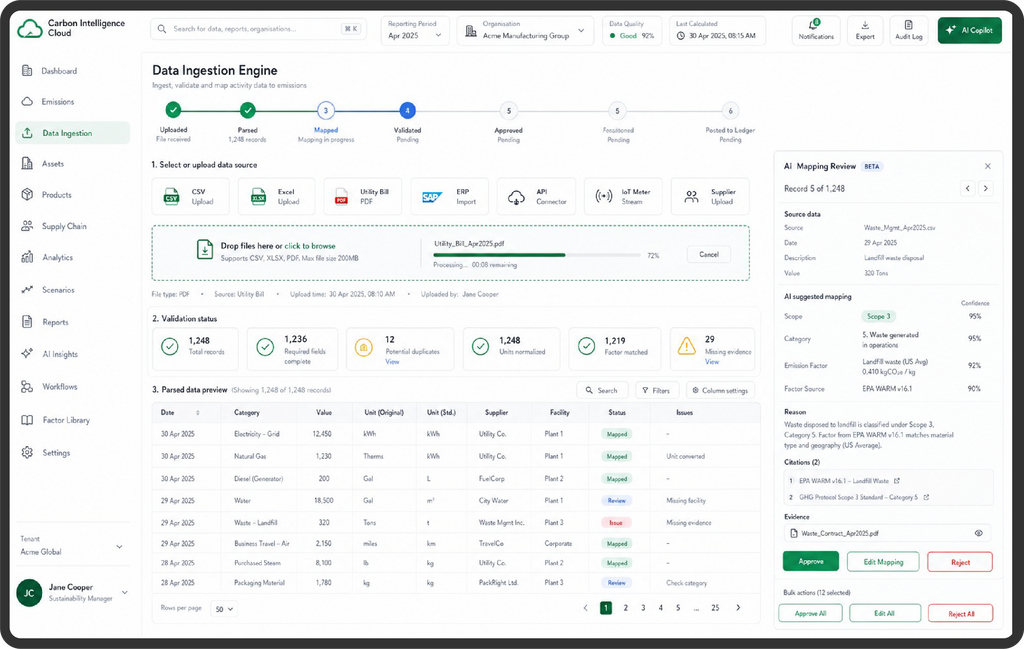
Automated Data Ingestion and Mapping
Collect and process activity, operational, supplier and financial datasets from spreadsheets, ERP systems, APIs, utility records, uploaded documents and enterprise platforms through AI-assisted ingestion and mapping workflows. Data is automatically structured, validated and assigned to the appropriate emissions categories, reporting entities and calculation methodologies.
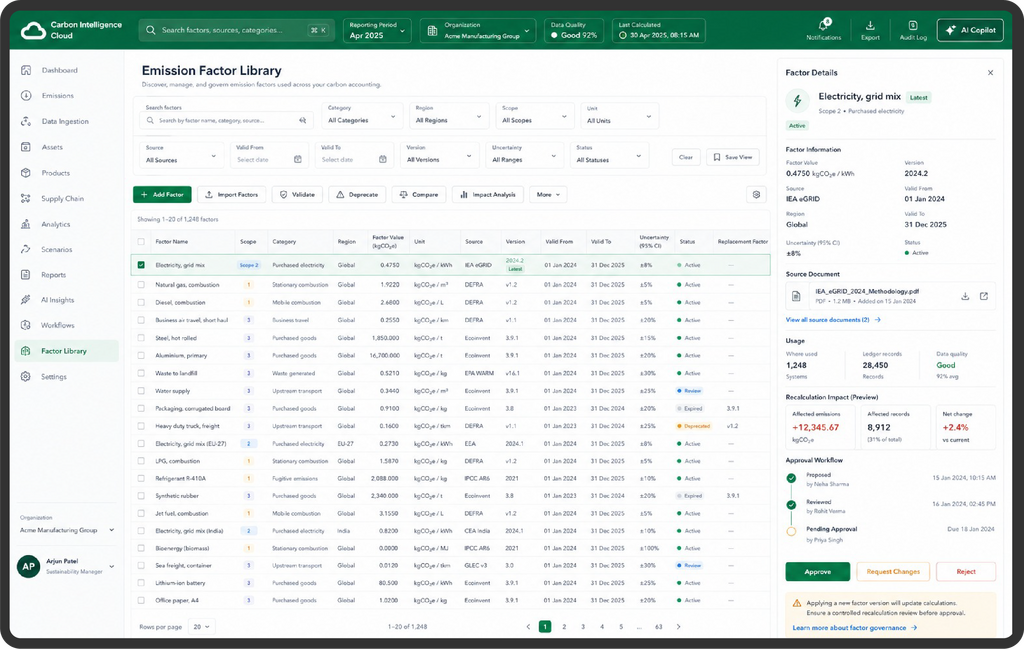
Emissions by Scope — Apr 2025
14,843
kgCO₂e total | ▲ 6.3% vs Mar 2025
Scope 1
15.8%
Scope 2
25.5%
Scope 3
58.7%
P&S (3.1)
36.8%
From raw data to reportable emissions, automatically.
CAP’s Emissions Module eliminates the manual effort of aggregating activity and ledger data to identify calculation methodologies, applying emission factors and reconciling sources. The platform aggregates the entered data to provide final report ready emission values.
Every calculation shows its workings: raw data value, emission factor, factor version, uncertainty and evidence files are all stored and searchable. Recalculation when factors update is instant across the entire ledger.
Emissions Explorer
Drill into any record by scope, category, supplier, facility or date range. Export and share views with approvers and auditors.
Supplier Emissions Intelligence
Capture, validate and analyse supplier emissions data across Scope 3 categories with integrated workflows and quality scoring.
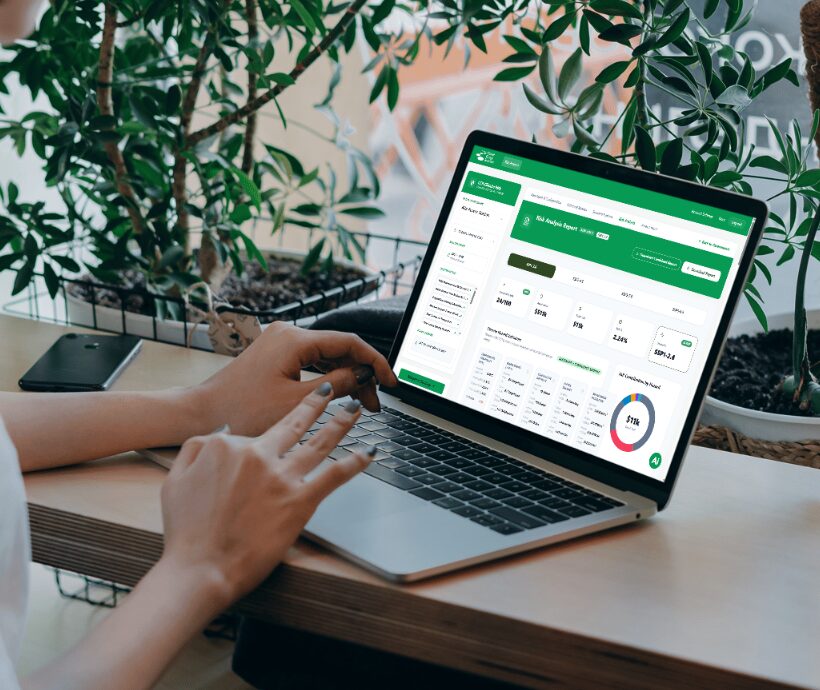
Dynamic Emission Factors
Automatically aligned to DEFRA, EPA, IPCC AR6 and other official sources, updated as new versions are released.
-
Assisted by Gen AI
Ask your emissions data anything.
The embedded AI Copilot answers complex questions about your emission drivers, surfaces reduction opportunities, generates narrative summaries for board reporting and flags anomalies before they become audit issues. Every answer is cited with the underlying ledger records.
-
Natural language queries
-
Cited source evidence
-
Anomaly detection
-
Narrative generation
-
Recommended next steps
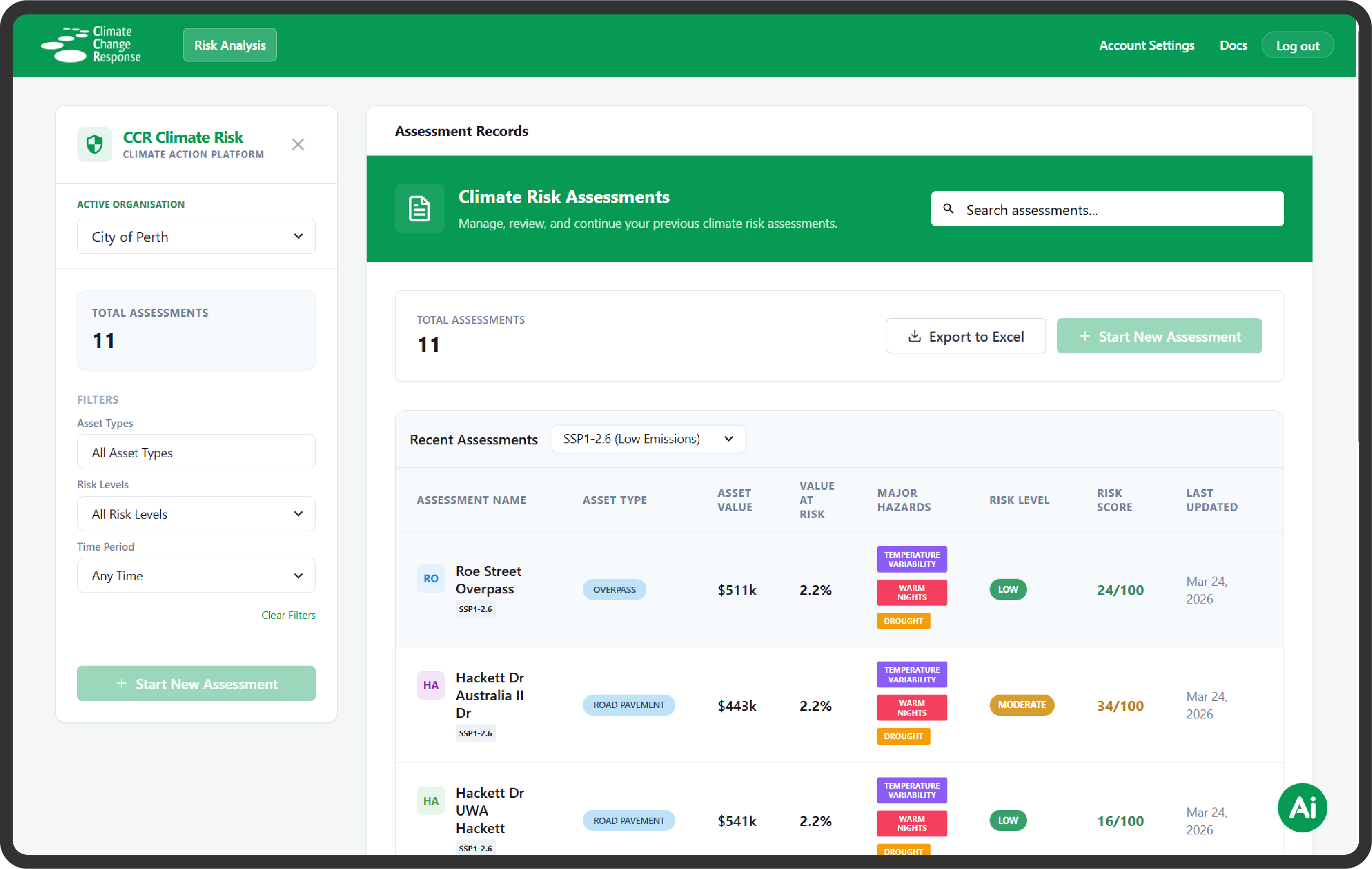
Physical Risks
Quantify the financial exposure of your assets and operations to physical climate hazards across multiple warming scenarios, with regulatory-ready outputs aligned to TCFD and IFRS S2.

Acute Physical Risk
IPCC AR6-aligned scenario modelling and downscaled regional climate datasets are used to assess the probability and financial impact of acute climate events including flooding, extreme heat, cyclones, wildfire and coastal inundation across assets, facilities and supply chain nodes. Asset-level exposure is quantified in financial terms with confidence ranges to support risk-informed planning and resilience decision-making.

Chronic Physical Risk
Assess long-run shifts in temperature, precipitation, sea level and drought frequency across 1.5°C, 2°C and 3°C warming scenarios. Understand how changing conditions affect operational continuity, capital expenditure needs and asset valuations over multi-decade horizons.

Scientific & Climate Modelling Foundation
CAP’s physical climate risk engine incorporates IPCC AR6-aligned climate pathways, CORDEX regional climate projections and high-resolution hazard datasets to support scientifically defensible climate risk and resilience analysis.
Value at Risk (VaR)
Translate risks into financial metrics that boards and investors understand. CAP calculates Climate Value at Risk across your asset portfolio, with outputs directly compatible with TCFD-aligned financial disclosures and lender climate assessments.
Marginal Abatement Cost Curve
Prioritise your decarbonisation investments with rigour. The MACC Curve ranks every available intervention by abatement potential and cost per tonne, giving leadership a clear, defensible view of where capital delivers the greatest climate impact.
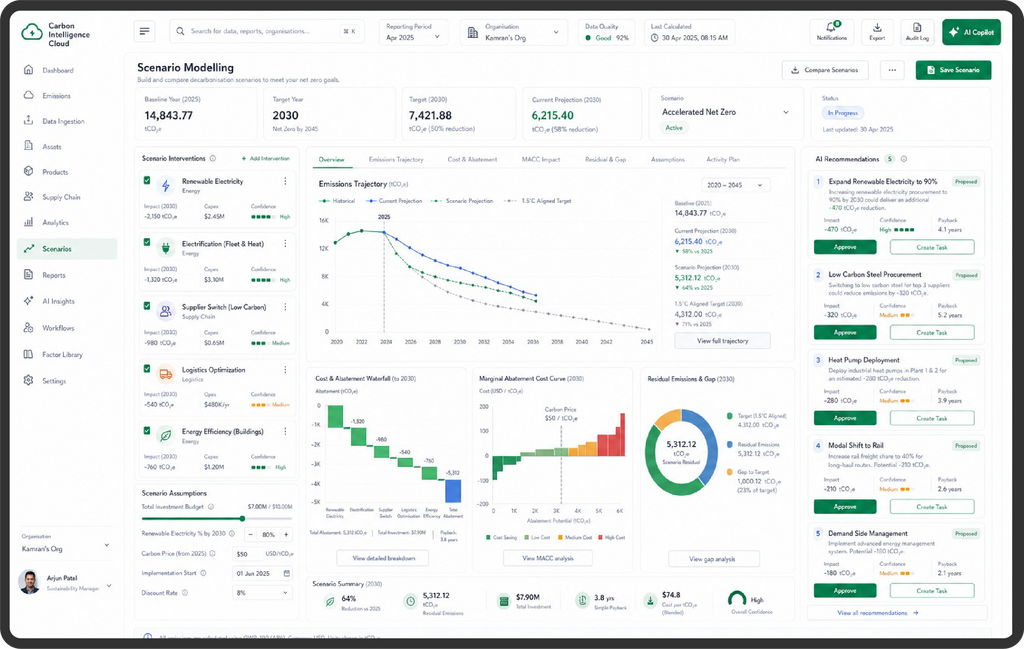
Find your cheapest tonne of carbon reduction first.
CAP builds your organisation’s MACC automatically from the scenario modelling engine, pulling in technology costs, operational savings, abatement potential and payback periods for every intervention you have identified. Interventions are ranked by Dollars per tCO₂e, making capital prioritisation straightforward and defensible.
The interactive curve lets leadership toggle carbon price assumptions, filter by scope or business unit, and export board-ready charts with a single click.
Abatement Opportunity Analysis
The platform surfaces and scores abatement opportunities you may not have considered, with confidence ratings and cited evidence.
Dynamic Carbon Pricing
Adjust the shadow carbon price assumption and watch the curve reprioritise in real time.
Export-Ready for Boards
One-click export of the full MACC chart and supporting data table in PDF or Excel, formatted for board packs and investor presentations.
Transition Risks
Model multiple decarbonisation trajectories, stress-test your decarbonisation commitments and understand the technology, policy and market transitions that will shape your business over the next decade and beyond. CAP supports NGFS-aligned scenario modelling and science-based transition pathway analysis to support resilient long-term planning.
Scenario Modelling | NGFS Aligned | SBTi Aligned | 1.5°C Pathways | Investment Planning

AI Assisted Engine
AI-generated decarbonisation recommendations are surfaced with every scenario run, each with impact estimate, confidence rating, VAR and a one-click approve-and-assign workflow to convert strategy into operational tasks.
Risk Library
A structured library of transition risks and adaptation considerations across operations, infrastructure, energy systems and supply chains. Each risk pathway includes associated financial exposure, operational impacts, adaptation responses and Climate VaR outputs to support scenario-based transition planning and resilience assessment.

Policy & Regulatory Risk
Assess exposure to evolving carbon pricing mechanisms, disclosure obligations, emissions intensity standards, procurement requirements and broader climate policy changes across jurisdictions and operating markets.

Technology Transition Risk
Identify assets and processes at risk of stranding as low-carbon technologies mature. Model the timing and cost of technology transitions against different carbon price trajectories and regulatory timelines.

Market Transition Risk
Analyse exposure to shifting customer demand, supply chain expectations, investor priorities and low-carbon market transitions. Assess potential revenue, cost and competitive impacts relative to sector decarbonisation pathways.

Reputation Risk
Understand potential impacts arising from stakeholder scrutiny, climate commitments, disclosure expectations and perceived transition readiness across investors, customers, regulators and communities.
Resilience Testing Module
Stress-test your strategy against the full range of climate futures. The Resilience Testing Module challenges your plans against disorderly transition, accelerated physical risk and regulatory shock scenarios to identify where your strategy holds firm and where it needs strengthening.

Multi-Scenario Stress Testing
Run your decarbonisation plan against NGFS, IEA and custom scenarios simultaneously. Identify which interventions remain viable under disorderly transition and which become stranded under accelerated policy action. Output a resilience summary ready for TCFD and IFRS S2 disclosure.

Strategy Gap Analysis
Quantify the gap between your current trajectory and your stated targets under each scenario. Understand the residual emissions that will require offsetting or removal technology, and model the associated cost under different carbon market conditions.

Regulatory Shock Modelling
Test the financial impact of sudden policy changes including carbon price floors, emissions intensity standards and mandatory product labelling requirements. Model how quickly your operations can adapt and what the transition costs will be under compressed timelines.

Publish-Ready Resilience Reports
Generate structured resilience summaries that meet TCFD, IFRS S2 and CSRD narrative requirements. Reports include scenario descriptions, key risk findings, strategic response and assurance status, ready to publish or submit to regulatory bodies.
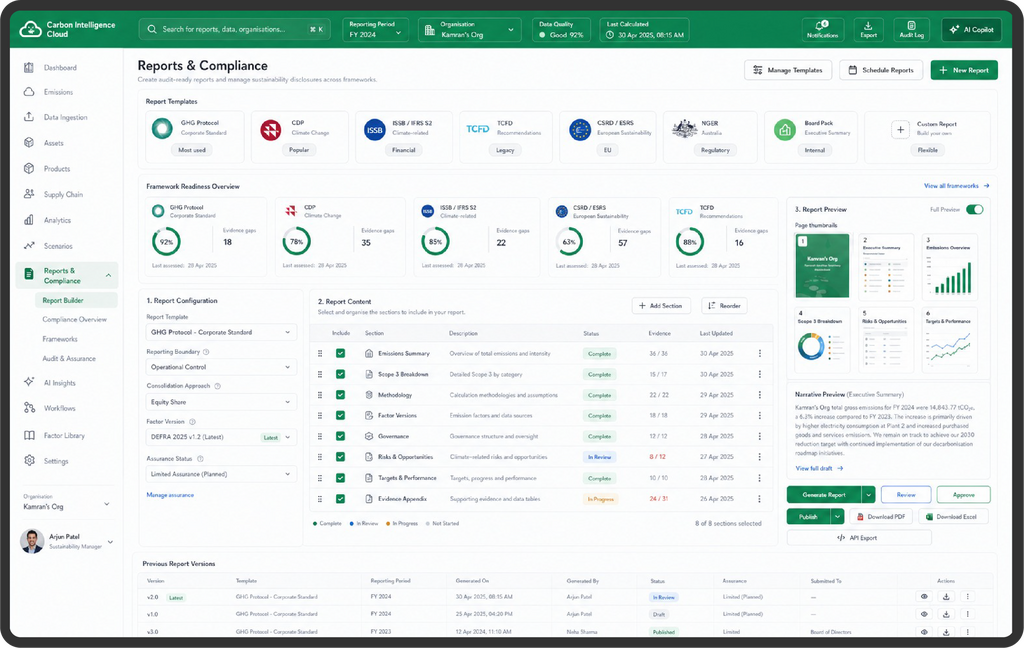
Reporting and Disclosure
Framework-aligned, publish-ready climate reports.
CAP’s Report Builder assembles your emissions data, risk analysis and scenario outputs into audit-ready disclosures across every major climate and sustainability framework. From first draft to published disclosure, everything is traceable back to the source record.
-
GHG Protocol
Corporate Standard
-
IFRS S2
Climate Disclosures
-
AASB / ASRS
Australian Standards
-
SBTi
Science-Based Targets
-
TCFD
Recommendations
-
CSRD / ESRS
European Sustainability
-
CDP
Climate Change
Everything you need to manage your climate programme.
01
Multi-step approval workflows with assigned owners, due dates, risk ratings and evidence requirements. Full audit trail from submission to approval.
02
Built-in data completeness, emission factor validation and supplier data quality controls with effectiveness scoring and open issue tracking.
03
Real-time data quality score across completeness, estimation, missing factors and invalid records with root-cause issue categorisation.
04
Compare your carbon intensity against industry average, top quartile and top decile peers segmented by sector, region and revenue band.
05
Year-end emissions forecasting, driver attribution, hotspot waterfall and factor version impact analysis across all scopes and business units.
06
Granular user permissions by module, organisation and data layer. Support for multi-tenant structures with subsidiary and group-level reporting.
Ready to take climate action?
Speak with a CCR specialist to see how CAP fits your reporting requirements, your risk profile and your decarbonisation timeline.