UK Sustainability Reporting Standards: Why Interpretation Now Matters More Than Disclosure
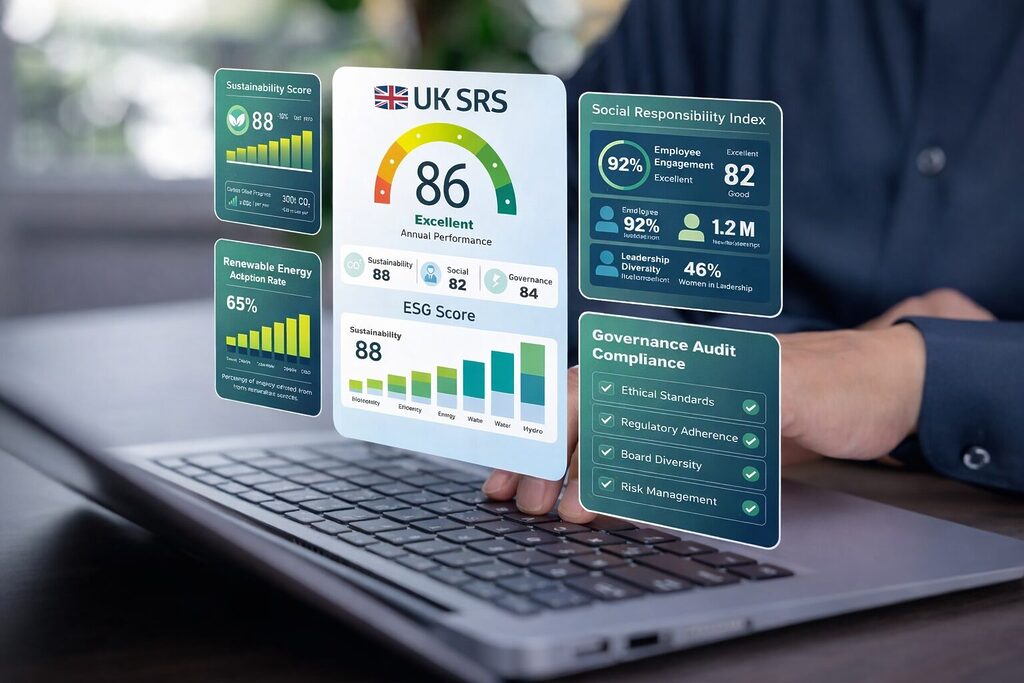
The United Kingdom has not lacked sustainability reporting frameworks.
Over the past decade, large organisations have aligned with a combination of Task Force on Climate-related Financial Disclosures recommendations, Streamlined Energy and Carbon Reporting, and disclosure expectations embedded within Financial Conduct Authority rules. Together, these have significantly expanded the volume and coverage of climate-related disclosures across the market.
However, this expansion has not resulted in a consistent reporting system.
Organisations have applied these frameworks in parallel, often with differing assumptions, organisational boundaries, and methodologies. While disclosures increased, they evolved in silos, shaped by internal interpretation rather than a single, enforceable structure.
In practice, this has led to three systemic challenges.
First, comparability remained limited. Similar disclosures across organisations often reflected different underlying assumptions, making like-for-like assessment difficult.
Second, consistency over time was weak. Changes in methodologies, boundaries, or data treatment reduced the reliability of trend analysis.
Third, the linkage to financial decision-making was often indirect. Sustainability disclosures existed alongside financial reporting, rather than being structurally integrated with it.
This is the context in which the UK Sustainability Reporting Standards emerge.
A move towards structured, decision-useful reporting
In February 2026, the UK introduced its Sustainability Reporting Standards, aligned with the baseline developed by the International Sustainability Standards Board.
Unlike previous frameworks, this is not an additional layer of guidance.
It is a structural consolidation.
The standards establish a unified framework built around:
- a general sustainability disclosure standard (S1), focused on financially material risks and opportunities
- a climate-specific standard (S2), covering emissions, scenario analysis, and climate risk
The distinction is critical.
Where earlier frameworks enabled flexibility in how organisations interpreted and applied guidance, UK SRS reduces that flexibility by defining:
- how disclosures are structured
- how assumptions are linked to outcomes
- how sustainability information connects to financial performance
This is not a shift towards more disclosure.
It is a shift towards enforceable consistency.
Sustainability reporting moves from a principles-led, interpretation-heavy model to a system where disclosures are expected to be comparable, repeatable, and decision-useful by design.
Why interpretation has become a defining factor
Historically, sustainability reporting has operated with a high degree of flexibility.
Organisations have:
- defined organisational and operational boundaries differently
- applied inconsistent methodologies across business units and reporting periods
- presented metrics and narratives without a common structure
This flexibility enabled adoption, but it also introduced fragmentation.
In practice, similar disclosures have often led to different interpretations. For investors and stakeholders, this has limited the ability to compare performance, assess risk, and make informed decisions.
The move to a standardised framework is intended to address this by introducing consistency in structure, assumptions, and financial linkage.
Interpretation is no longer a by-product of reporting.
It becomes the central test of whether reporting is effective.
From narrative reporting to comparability
The transition underway is not from non-disclosure to disclosure.
It is a structural shift:
- from narrative-heavy reporting to structured datasets
- from organisation-specific interpretation to standardised presentation
- from standalone ESG disclosures to financially connected reporting
Disclosures are increasingly assessed not only on completeness, but on:
- alignment with defined methodologies
- consistency across reporting periods
- integration with financial context
This raises the bar for reporting quality and reduces tolerance for internal variation.
The Real Challenge Is Not Disclosure. It Is Integration
Most organisations underestimate the operational shift required.
Climate risk under CSRD is not a reporting exercise led by sustainability teams. It requires integration across:
- Enterprise risk management
- Financial planning and analysis
- Asset and capital allocation strategies
- Supply chain and operational resilience
For example, physical risk must inform asset valuation assumptions, maintenance cycles and insurance strategies. Transition risk must be embedded into demand forecasts, regulatory cost modelling and investment decisions.
Without this integration, disclosures remain disconnected from how the business is actually run.
Strengthening the link to financial performance
A defining feature of the UK standards is their emphasis on financial materiality.
Organisations are required to disclose sustainability-related risks and opportunities that could reasonably affect:
- cash flows
- access to finance
- cost of capital
This introduces a higher level of discipline.
It requires:
- alignment between sustainability metrics and financial assumptions
- integration with planning, forecasting, and scenario analysis
- consistency between sustainability disclosures and financial statements
This does not replace existing reporting practices.
It formalises and connects them within a single, decision-useful framework.
Where organisations are likely to face pressure
For most organisations, the challenge will not be generating new disclosures.
It will be reconciling existing disclosures within a consistent structure.
Pressure will emerge where:
- methodologies differ across business units or geographies
- assumptions are not clearly defined, documented, or repeatable
- sustainability disclosures are not aligned with financial narratives
- scenario analysis lacks consistency across time horizons
- data flows are fragmented across systems and teams
These are not new issues.
They are existing gaps that become visible under standardisation.
Organisations that have relied on flexibility will need to transition to discipline.
What leading organisations are doing differently
Organisations that are progressing effectively are not increasing the volume of disclosure.
They are improving the quality and usability of what already exists.
This includes:
- aligning sustainability disclosures with financial narratives and assumptions
- standardising methodologies across the organisation
- structuring data so that it is consistent from source systems through to reporting outputs
- ensuring comparability across reporting periods and against peers
The focus is shifting from reporting activity to reporting integrity.
The CCR perspective
The shift underway in the UK reflects a broader global transition.
Sustainability reporting is moving towards systems that are:
- structured
- comparable
- audit-ready
- aligned with financial decision-making
Delivering this consistently requires more than advisory support.
It requires integrated systems that can manage data, methodologies, and outputs across reporting cycles without introducing variability.
At CCR, this is addressed through a combination of domain expertise and a purpose-built, bespoke technology suite designed to align with organisational structures and UK Sustainability Reporting Standards.
This includes:
- delivering end-to-end advisory across sustainability, risk, and financial integration aligned to UK SRS requirements
- enabling audit-ready data trails and automated reporting workflows to reduce manual intervention
- configuring bespoke technology environments that align with organisational boundaries and reporting structures
- supporting multi-framework reporting, including ISSB-aligned standards and legacy frameworks, within a single system of record
- embedding AI-driven insights to translate complex datasets into decision-useful outputs
- enabling scenario analysis and physical risk assessment at asset and portfolio levels with consistent methodologies
The focus is not on adding layers to reporting.
It is on enabling organisations to operate within a coherent system where disclosures are inherently consistent, comparable, and decision-useful.
What happens next
The UK Sustainability Reporting Standards establish a clear direction.
As adoption progresses, three trends are likely to accelerate:
- increased scrutiny on the consistency of methodologies and assumptions
- growing expectations around auditability and assurance of sustainability data
- deeper integration of sustainability metrics into financial decision-making
Organisations that treat this as a reporting exercise will face increasing friction.
Those that treat it as a systems and integration challenge will be better positioned.
Closing perspective
The UK has reached a point where disclosure is no longer the differentiator.
The next phase is defined by how clearly information can be interpreted, compared, and trusted.
In this environment, advantage will not come from reporting more.
It will come from reporting with clarity, consistency, and discipline.